

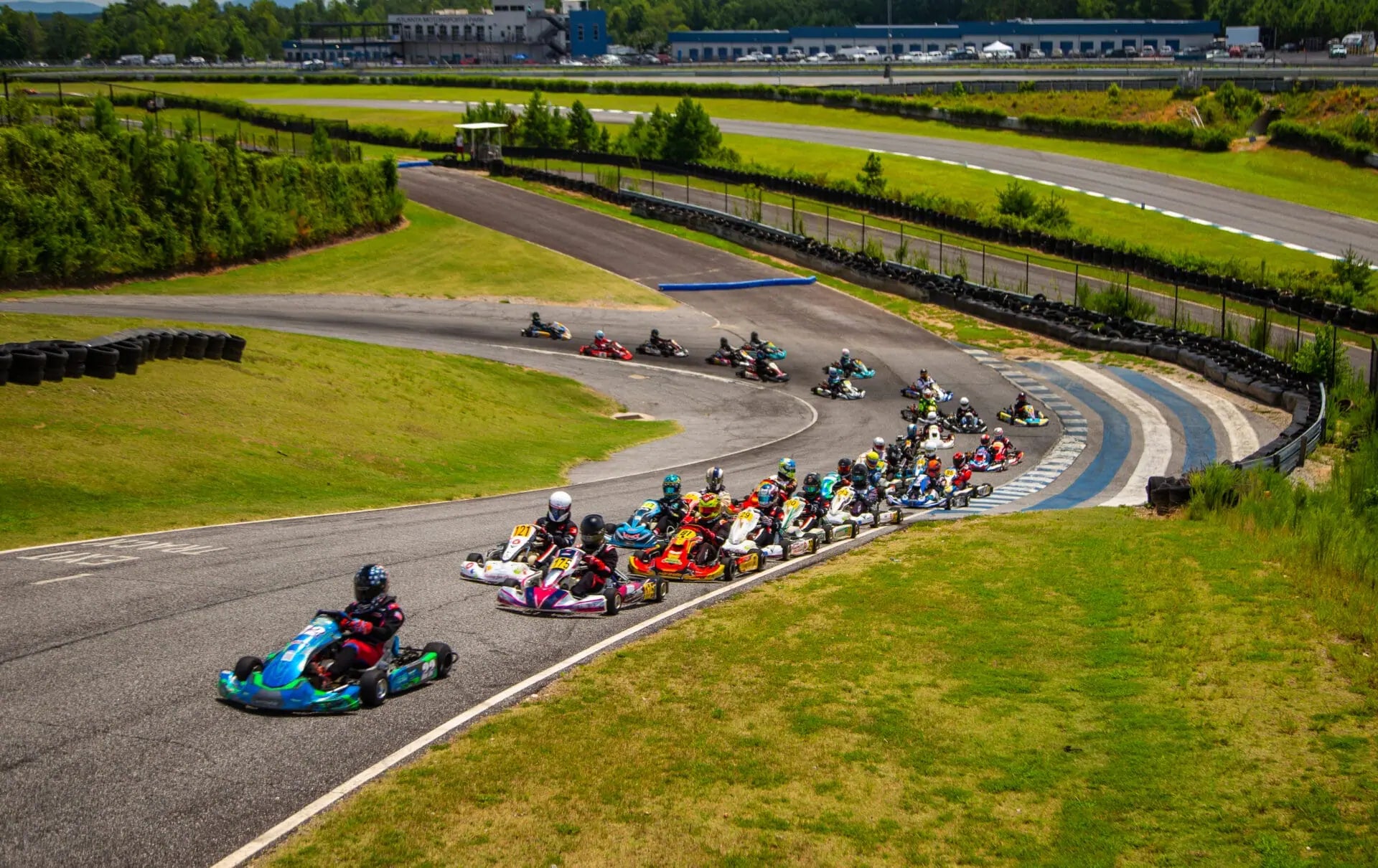
If you're a karting family, you already know what the sport costs. You've done the math. You've felt the math. Entry fees, tires, engines, fuel, travel, hotels, spare parts, the trailer, the tow vehicle, and the weekends that somehow always cost more than you budgeted.
Now add this to the equation: a piece of equipment that gives your kid unlimited practice time, teaches them real driving skills, and never burns through a set of tires.
That's why karting families are putting simulators in their homes. Not as a toy. Not as a distraction. As a deliberate, strategic part of their driver development program.
The Economics Make Immediate Sense
Let's start with the numbers because for most karting families, the financial conversation is the one that opens the door.
A competitive karting season at the regional level runs somewhere between $15,000 and $30,000 for a single driver. At the national level, that number climbs significantly higher. The largest line items are tires, entry fees, and travel. Every practice day at the track costs fuel, tires, and often a facility rental fee.
A quality home simulator capable of developing real driving skills costs between $4,500 and $7,000 for a complete setup with a proper wheelbase, load cell pedals, a rigid chassis, and a screen.
That's two race weekends. Maybe three.
Once the rig is built, the cost of practice is effectively zero. No consumables. No entry fees. No travel. Your kid can turn 200 laps on a Tuesday night and the only thing it costs you is electricity.
This doesn't replace track time. Nothing replaces track time. But it dramatically reduces how much track time you need to spend on learning and lets you focus your real world sessions on refinement and racing.
What the Simulator Actually Teaches a Kart Racer
Here's where skepticism usually shows up. Parents who haven't experienced modern simulation often assume it's too far removed from the feel of a kart to provide real developmental value. That assumption is outdated.
Track Knowledge
This is the most straightforward benefit and the one every karting family notices first.
If your kid is traveling to a new track for a regional or national event, the simulator lets them learn the circuit before they arrive. Every corner, every braking reference, every line choice. By the time they unload the kart on Friday morning, they already know where they're going.
This translates directly into fewer "learning" sessions at the track, which means less tire wear, less fuel consumption, and more productive practice laps. At a national event where practice time is limited and every session matters, showing up already knowing the track is a measurable advantage.
Racecraft
This is the benefit that surprises people the most.
Karting is a contact sport. Not literally (though sometimes literally), but in the sense that it's defined by close, aggressive, wheel to wheel racing. Managing a draft. Defending a position. Timing a pass into a tight corner. Reading the driver ahead of you. Staying calm when someone puts a bumper on you.
These skills are difficult to develop in solo practice sessions at the track. They require traffic. They require competition. They require repetition in race conditions.
Online sim racing provides exactly that. Platforms like iRacing, which has kart specific content, or multiplayer racing in car based sims with competitive communities, put your kid in race situations against real, unpredictable human opponents every single day. The racecraft they build in these environments transfers directly to the kart because the skills are the same: spatial awareness, patience, decision making under pressure, and the ability to execute a plan while everything around them is chaotic.
Braking Technique
If your kid's simulator has a load cell brake pedal, they're building muscle memory every time they drive. Pressure based braking is the same fundamental input mechanism in a kart and in a sim. The force levels are different, but the neuromuscular pattern of modulating pressure with the foot is identical.
Kids who practice braking on a load cell develop smoother, more consistent technique than kids who only brake in the kart. This shows up immediately on data traces. Their braking is more repeatable, their threshold braking is more precise, and their trail braking transitions are cleaner.
Consistency
Fast laps win qualifying. Consistent laps win races.
A simulator lets your kid practice consistency in a way that the track can't match, simply because the cost of repetition is zero. They can run 50 consecutive laps, review their telemetry, identify where they're losing tenths to inconsistency, and immediately go back out to work on it.
At the track, that same exercise would cost a full set of tires and an hour of track time. In the sim, it costs nothing and can be done any night of the week.
Coaches Are Recommending It
This isn't just parents making the investment on their own. Karting coaches at every level are now actively incorporating sim training into their development programs.
The reasons are practical. A coach can assign homework in the simulator. "Run 30 laps at Road America, focus on being smooth through the carousel, and send me your telemetry." The student practices between coaching sessions, and the next time they meet, the coach has data to review and specific corrections to make.
This feedback loop, practice then review then correct then practice again, is the foundation of all skill development. The simulator compresses the timeline. Instead of waiting for the next track day to work on a weakness, the kid can work on it tonight.
Some coaches are running virtual coaching sessions entirely in the sim, watching their student drive in real time, pausing to discuss technique, and immediately resuming to apply corrections. The iteration speed is dramatically faster than anything possible at the track, and the cost to the family is a fraction of an in person session.
The Age Factor
Karting starts young. Competitive kart racers in the five to eight year old cadet classes are developing motor skills and racing instincts that will define their trajectory for years. By the time they reach junior and senior categories, the technical demands increase exponentially.
A simulator meets young drivers where they are developmentally. At six or seven years old, a kid can learn basic track layouts and develop steering coordination. At ten or eleven, they can work on braking technique and racecraft. At fourteen or fifteen, they can analyze telemetry, experiment with different driving approaches, and develop the kind of self awareness that defines mature, competitive drivers.
The rig grows with them. An adjustable chassis can be reconfigured as they get taller. The software complexity can increase as they're ready for it. A simulator purchased when a kid starts karting at age eight can remain relevant and useful through their entire karting career and beyond.
What to Look for in a Karting Family Simulator
Not every sim rig is ideal for a developing kart racer. Here's what matters most:
Kart specific software. KartKraft and certain iRacing content include kart specific physics and handling models. Practicing in a kart sim rather than a car sim ensures your kid is developing habits appropriate to the vehicle they actually race. Car racing and kart racing involve fundamentally different techniques, and practicing one can sometimes create counterproductive habits for the other.
Load cell pedals. This is non negotiable for development purposes. Position based pedals teach the wrong braking technique. Pressure based pedals teach the right one.
Appropriate wheel force. Young kart racers don't need a 25Nm direct drive wheelbase. They need clean, detailed force feedback at a level their hands can manage. A 5 to 8Nm wheelbase is ideal for most young drivers.
Adjustable chassis. Kids grow fast. Your rig needs to accommodate that growth without requiring a complete rebuild every 18 months. Aluminum profile frames with adjustable pedal trays, seat positions, and wheel height are the best solution.
A seat that fits. A full size racing bucket designed for an adult will swallow a 10 year old. Consider starting with a smaller seat or a karting seat mounted to the chassis, then upgrading to a full size seat as they grow into it.
The Intangible Benefit Nobody Talks About
There's one more reason karting families are investing in home simulators, and it has nothing to do with lap times or racecraft.
It keeps the passion alive between races.
Karting is a weekend sport for most families. You race Saturday, maybe Sunday, and then the kart goes back in the trailer until the next event. For a kid who lives and breathes racing, those weekdays in between can feel like an eternity.
A simulator gives them racing every single day. It keeps them engaged, keeps them thinking about driving, and keeps the fire burning that makes all the sacrifice and expense worthwhile. A kid who is genuinely excited to go practice in the sim on a Wednesday evening is a kid who is going to show up at the next race weekend fully locked in.
That intangible, the sustained engagement and passion, might be the most valuable thing the simulator provides. Because at the end of the day, no amount of equipment or coaching matters if the kid loses interest.
The Bottom Line
A home simulator is the single most cost effective training tool available to a karting family. It teaches real skills, provides unlimited practice at zero marginal cost, compresses the development timeline, and keeps young drivers engaged between events.
The families who are investing in them aren't doing it because it's trendy. They're doing it because they've seen the results on the data, on the stopwatch, and on the face of their kid when they show up at the track already knowing every corner.
RRG Racing builds simulators tailored to young drivers and the families who support them. We spec rigs that fit their size now and adjust as they grow, with the right software, the right inputs, and the right level of capability for where they are in their development. Based at Atlanta Motorsports Park in Dawsonville, Georgia. Visit rrgracing.com to build the right rig for your racer.
Share:
Active Pedals vs Hydraulic vs Load Cell: Which Pedal System Is Right for You?
What to Look for When Buying a Simulator for Your Kid's Racing Development