

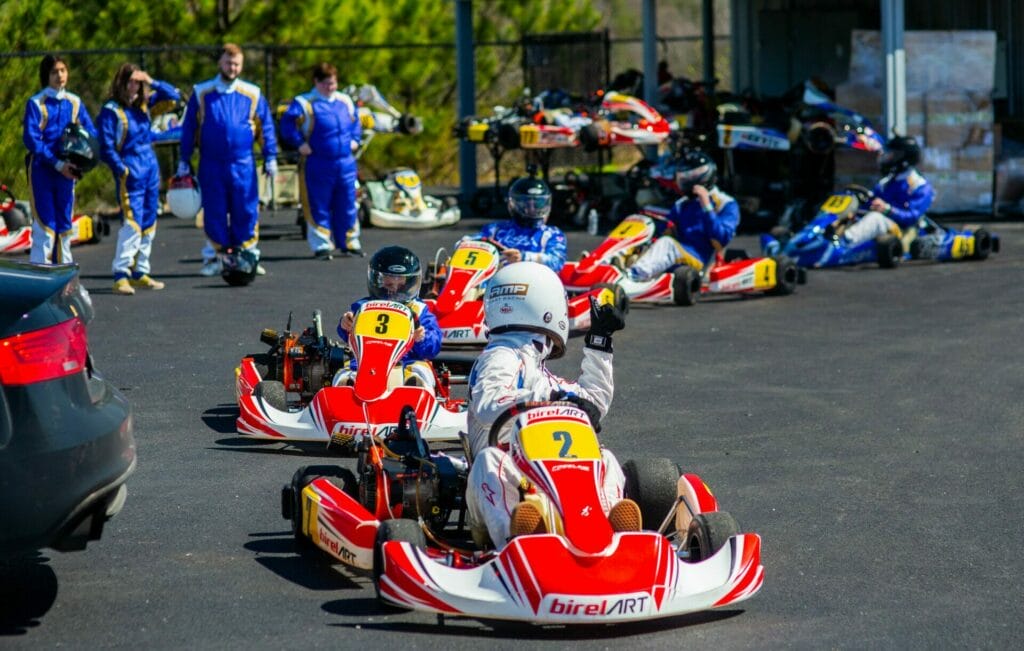
Your kid is fast. Maybe they've been tearing up the local karting scene, maybe they just got their first taste of wheel to wheel racing and can't stop talking about it. Either way, you're here because you've started asking the question every racing parent eventually lands on:
"Would a simulator at home actually help?"
The short answer is yes. The longer answer is that it depends entirely on what you buy, how it's set up, and whether the equipment matches where your kid is right now versus where they're headed. A simulator can be the best investment you make in their development, or it can be an expensive distraction that teaches bad habits.
Here's how to get it right.
Start With Why
Before you look at a single piece of hardware, get honest about the goal. Simulators can serve a lot of purposes, and the right build changes depending on which one matters most to your family.
Learning new tracks. If your kid is moving up through regional or national karting series, they're going to face unfamiliar circuits. A simulator lets them learn the layout, braking references, and racing lines before they ever arrive at the track. That means fewer "figuring it out" sessions burning through tires and entry fees.
Building racecraft. Online racing against real people teaches things that solo practice can't: defending position, managing dirty air, staying calm in traffic, reading other drivers. These are the skills that separate a fast kid from a winning kid.
Seat time between race weekends. Not everyone can get to the track every week. A simulator keeps their instincts sharp and their focus dialed in between events.
Fun. Don't underestimate this one. If your kid genuinely loves driving, giving them a way to do it at home keeps that fire burning. Passion is the engine behind everything else.
The Equipment That Actually Matters
Here's where most parents either overspend in the wrong places or underspend where it counts. A kid's simulator doesn't need to look like a NASA cockpit, but it does need to get a few things right.
The Wheelbase
This is the motor that drives the steering wheel and provides force feedback. It's the single most important piece of equipment on the rig because it's how your kid feels the car.
For a young developing driver, a quality belt driven or entry level direct drive wheelbase is the sweet spot. You don't need the most powerful unit on the market. Kids are lighter, their hands are smaller, and a wheel pumping out 25Nm of torque is going to overpower a 10 year old. Look for something in the 5 to 8Nm range that provides clean, detailed feedback without being physically overwhelming.
What to avoid: toy grade wheels with no force feedback or vague, spongy resistance. If the wheel doesn't communicate what the tires are doing, the simulator isn't teaching anything. It's just a video game.
The Pedals
If you read nothing else in this article, read this section.
Pedals matter more than the wheel for developing a young racer. Braking technique is the foundation of fast, consistent driving, and the pedal set is what teaches it. A load cell brake pedal measures pressure rather than travel, which means your kid builds the same muscle memory they'll use in a real car.
Budget pedals that use potentiometers (position based sensors) teach your kid to brake based on how far they push the pedal. That's the opposite of how a real brake system works, and the habit is hard to unlearn.
You don't need to spend $800 on pedals for a 12 year old. But you do need a load cell brake. This is non negotiable for development purposes.
The Chassis and Seat
Kids grow. Fast. This is probably the most important practical consideration and the one most families don't think about until it's too late.
Look for a rig with adjustable pedal distance, seat position, and wheel height. Aluminum profile (extruded aluminum) chassis are ideal for this because they can be reconfigured with basic tools as your kid grows. A rig that fits them perfectly at age 10 needs to still work at age 14, or you're buying twice.
The seat itself should hold them securely without swallowing them. Some families start with a smaller bucket seat or even a karting seat mounted to the chassis, then swap to a full size seat later. What matters is that they're sitting in a position that mirrors how they sit in their kart or car: arms slightly bent, legs slightly bent, able to reach full pedal travel without stretching.
Screens and Visibility
Triple monitors are great, but they're not essential for a young driver just starting out. A single quality monitor at the right size and distance can be perfectly effective, especially if field of view (FOV) is set correctly in the sim software.
What actually matters here is that your kid can see their surroundings well enough to race other people. If they can't spot a car alongside them or judge the apex of a corner because the screen is too small or too far away, that's a problem worth solving. A single 32" to 49" ultrawide at the correct distance is a solid starting point.
VR is an option, but for younger drivers it can cause discomfort during long sessions, and many parents prefer their kid racing on a screen they can watch and coach from behind.
The Software
Not all sims teach the same skills. Choosing the right platform for your kid's specific racing discipline makes a real difference.
For karting development: Look at KartKraft or sim titles that offer kart specific physics. Karting is a completely different driving discipline than car racing, and practicing in a GT car when your kid races karts can actually build conflicting habits.
For car racing development: iRacing is the gold standard for competitive online racing and has an enormous community, structured license progression, and real consequences for on track behavior. Assetto Corsa and Assetto Corsa Competizione are excellent for learning car control and specific GT platforms.
For general racecraft: Any multiplayer sim with a healthy online community will sharpen your kid's ability to race in traffic. The key is that they're racing against people, not AI. Human opponents are unpredictable, emotional, and occasionally unfair, which is exactly what real racing is like.
What You Don't Need (Yet)
It's tempting to build the ultimate rig right out of the gate. Resist that urge. Here's what can wait:
Motion platforms. Your kid doesn't need motion to develop their driving skills. It's a fantastic tool at higher levels, but at the development stage, a rigid static rig with good force feedback and pedals teaches everything they need.
Top tier direct drive wheelbases. A 25Nm base is wasted on a child. They can't physically manage the forces, and the extra power provides no developmental benefit at this stage. Save the flagship wheelbase for when they're older and stronger.
The Real Value: Coached Sim Time
Here's something most parents overlook entirely. A simulator is a tool. Like any tool, it's only as effective as how it's used.
An hour of focused, coached sim time is worth more than ten hours of your kid hot lapping alone with music blaring. If your kid is serious about development, consider how the simulator fits into their overall coaching program.
Some things a coach can do with sim data that they can't easily do at the track:
Immediate review. Most sim platforms allow telemetry recording. A coach can sit with your kid, review their braking points, throttle application, and line choice in real time, then have them go back out and apply corrections immediately. At a real track, that feedback loop takes an entire session.
Comparison laps. Many sims let you load a ghost car or overlay telemetry from a reference lap. Your kid can see exactly where they're losing time and what the faster driver is doing differently.
Low pressure repetition. The track is expensive and high pressure. The simulator is free (after the initial investment) and low stakes. That's the perfect environment for working on specific weaknesses without the anxiety of bending a kart or wasting a set of tires.
A Word About Screen Time Concerns
Let's address this directly, because it comes up in almost every conversation with racing parents.
Yes, a simulator involves a screen. Yes, your kid will want to spend a lot of time on it. That's not inherently a problem, as long as the time is structured and purposeful.
Sim racing is a physical and mental activity. It requires focus, physical coordination, and decision making under pressure. It's not passive consumption. A kid doing a 30 minute race stint is engaged in a way that's fundamentally different from scrolling a phone or watching videos.
That said, set boundaries. Structured sessions with goals (learn this track, practice this technique, race this league event) are more valuable than unlimited free play. Treat the simulator the way you'd treat any other piece of training equipment: with intention.
Budgeting Realistically
Here's a rough breakdown of what a proper development rig costs in 2026:
Wheelbase (belt or entry direct drive): $350 to $700 Wheel rim (appropriately sized): $150 to $350 Pedals (with load cell brake): $250 to $600 Chassis (aluminum profile, adjustable): $400 to $900 Seat: $150 to $400 Single monitor or ultrawide: $300 to $700 PC (capable of running sims smoothly): $800 to $1,500 Sim software and subscriptions: $50 to $200/year
Total range: roughly $2,450 to $5,350 for a proper rig that will grow with your kid and teach real skills.
That might sound like a lot until you calculate what a single race weekend costs in entry fees, tires, fuel, travel, and lodging. For most racing families, the simulator pays for itself within a few months of reduced track expenses and dramatically improved on track performance.
Final Thought
A racing simulator is the only piece of training equipment that lets your kid practice every single aspect of driving, from braking technique to racecraft to mental endurance, without burning a dollar in consumables. No tires. No fuel. No entry fees. No travel. Just focused repetition in a controlled environment.
But it only works if the equipment is right, the setup fits their body, and the time they spend in it is purposeful.
Get those three things right, and you won't just see the improvement on the data. You'll see it the next time they hit the track.
RRG Racing builds turnkey simulators for drivers at every stage, including the ones who aren't old enough to have a license yet. If your family is exploring a development rig for your young racer, we'll help you spec the right setup for their size, their discipline, and their goals without overselling what they don't need. Based at Atlanta Motorsports Park in Dawsonville, Georgia. Visit rrgracing.com to keep ahead of the curve.
Share:
Why Karting Families Are Investing in Home Simulators
Track Day Prep: Using a Simulator to Learn a Circuit Before You Arrive