

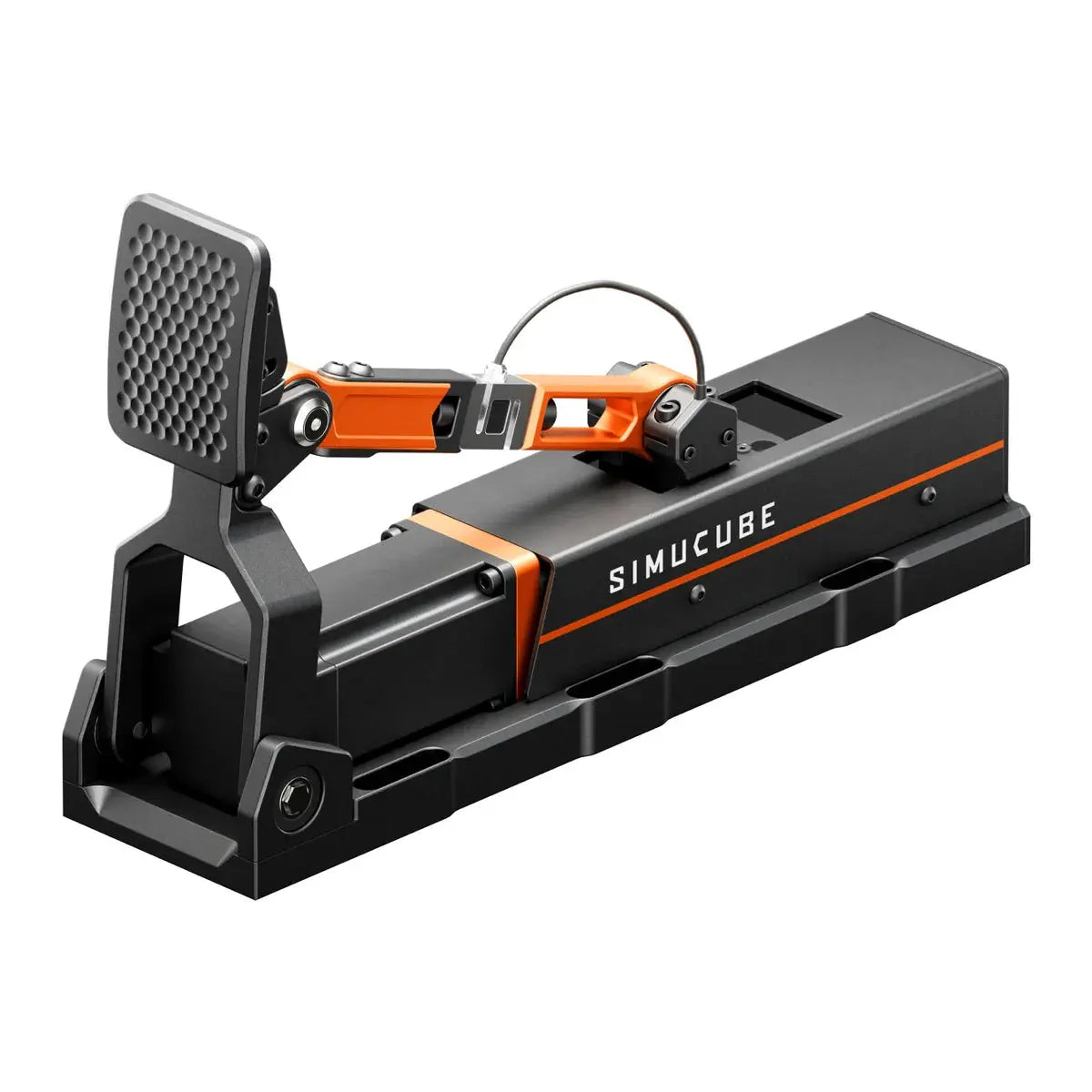
Ask any experienced driver, real or sim, what the most important input is, and they'll tell you the same thing: braking. Not steering, not throttle application, not trail braking theory. The ability to hit a precise braking point, modulate pressure through the corner entry, and release at exactly the right moment is what separates fast drivers from everyone else.
And yet, pedals are one of the most overlooked components in a sim racing rig.
Most buyers spend weeks agonizing over wheelbases, screens, and chassis, then grab whatever pedals fit the leftover budget. That's a mistake. Your feet are doing more work than your hands on every single lap, and the quality of the feedback they receive directly affects your consistency, your confidence, and your pace.
So let's talk about the three pedal technologies that matter right now: load cell, hydraulic, and active pedals. What they do, how they feel, and most importantly, which one is actually worth your money.
Load Cell Pedals
What's happening inside: A load cell pedal uses a strain gauge sensor that measures how hard you press, not how far. This is a critical distinction. Instead of the pedal responding to travel (like a potentiometer in a budget pedal set), it responds to pressure. The harder you push, the more braking force is applied.
Why they changed the game: Before load cell pedals became widely available, sim racers were braking based on pedal position. Push it halfway down, get 50% braking. Push it all the way, get 100%. The problem is that real cars don't work like that. In a real car, you modulate braking with the ball of your foot, applying and releasing pressure in tiny increments. Your muscle memory is built around force, not distance.
Load cell pedals brought that same relationship into the sim. Suddenly, drivers could develop real muscle memory in their braking foot, and lap time consistency improved across the board.
The feel: Firm, progressive, and predictable. Most quality load cell pedals have adjustable preload and elastomer stacks that let you tune the stiffness and travel to your preference. The sensation is closer to a real car than any potentiometer pedal, but it still lacks the fluid, organic resistance that a real hydraulic brake system provides.
Who they're for: Load cell pedals are the standard for anyone serious about sim racing. They're the sweet spot of performance, reliability, and value. If you're coming from a basic pedal set, upgrading to load cells will be the single biggest improvement you make to your driving.
Price range: $300 to $1300 for standalone sets from brands like Heusinkveld, Simucube, and Simagic.
Hydraulic Pedals
What's happening inside: Hydraulic pedals use actual fluid displacement to create resistance, the same fundamental principle as the braking system in your road car or race car. When you press the brake pedal, you're pushing a piston into a sealed cylinder filled with hydraulic fluid. The resistance builds progressively and organically in a way that no spring or elastomer stack can perfectly mimic.
Why they exist in sim racing: Load cell pedals measure force accurately, but the way they build resistance is mechanical. Elastomers compress, springs deflect, and the result is good but ultimately a simulation of what hydraulic pressure feels like. Hydraulic pedals skip the approximation entirely. The resistance curve you feel under your foot is the real thing.
The feel: This is where hydraulic pedals separate themselves. The progression from light initial pressure to firm, deep braking feel is seamless. There's no "stacking" sensation that you sometimes get with elastomers. No sudden wall at the end of travel. Just a smooth, fluid buildup of resistance that your foot intuitively understands because it's the same physics your body has felt every time you've pressed the brake pedal in a real vehicle.
Who they're for: Drivers who want the most realistic pedal feel available in a non active system. If you're training for real track days or competition and want your simulator pedal to feel indistinguishable from a race car's, hydraulic is the answer. They're also popular with drivers who have real seat time and find that load cell elastomers just don't feel "right" compared to what they're used to in the car.
The tradeoffs: Hydraulic systems are more complex. They can develop leaks, require occasional bleeding, and are sensitive to temperature changes that affect fluid viscosity. Maintenance is minimal but it does exist, and it's more involved than swapping an elastomer.
Price range: $800 to $2,000+ for quality hydraulic pedal sets.
Active Pedals
What's happening inside: Active pedals use high speed servo motors or linear actuators with real time software control to dynamically change what you feel under your foot while you're driving. The pedal isn't just reacting to your input with a fixed resistance curve. It's actively pushing back, vibrating, softening, and stiffening based on what's happening in the simulation.
Lock up the brakes? The pedal pulses under your foot like real ABS intervention. Lose tire grip mid corner? The brake pedal subtly changes feel to reflect the reduced traction. Flat spot a tire? You feel it every time you touch the brake for the rest of the stint.
This isn't a fixed mechanical feel. It's a living, software controlled feedback loop that mirrors the telemetry data from the sim in real time.
Why they're the new frontier: Load cells brought pressure based braking to sim racing. Hydraulics brought realistic resistance curves. Active pedals bring context. They don't just tell your foot how hard you're pressing. They tell your foot what the car is doing, and that's an entirely different category of information.
In a real race car, the brake pedal feels different depending on tire condition, brake temperature, pad wear, ABS activation, and surface grip. Active pedals replicate all of those variables. For the first time, the pedal under your foot is a dynamic feedback device, not just an input mechanism.
The feel: Surreal, if we're being honest. The first time you experience ABS pulsing through an active brake pedal, or feel the resistance drop when you cook the brakes into a heavy zone, it rewires your expectations. It's the closest any sim pedal has come to making your foot believe it's in a real car.
Who they're for: Sim racers and real world drivers who want absolute top tier immersion and training transfer. Active pedals are the current pinnacle of pedal technology, and they pair especially well with motion platforms and high fidelity simulation software. If your goal is to blur the line between simulator and reality as completely as possible, this is the pedal system that does it.
The tradeoffs: Cost is the obvious one. Active pedals are the most expensive option on this list by a significant margin. They also require software configuration, firmware updates, and compatibility with supported sim titles to deliver on their promise. A poorly configured active pedal can feel gimmicky. A properly tuned one feels like nothing else.
Price range: $2,500 to $5,000+ and climbing as the technology matures.
So, Which One Should You Buy?
This is where things get personal. All three technologies can make you faster if they're an upgrade from what you currently have. But the "right" choice depends entirely on what you value and where you are in your sim racing journey.
If you're upgrading from potentiometer pedals: Go load cell. Don't overthink it. The jump from position based to pressure based braking is the most significant pedal upgrade you will ever make. Everything else builds on this foundation.
If you already have load cells and want more realism: Hydraulic pedals are the natural next step. The resistance feel is more organic, the progression is smoother, and drivers with real car experience will immediately feel at home. It's a refinement of what load cells started.
If realism and training transfer are your top priorities: Active pedals are the move. Nothing else gives you dynamic, context aware feedback that changes based on what's happening in the sim. For professional drivers, coaching programs, and enthusiasts building the ultimate rig, active pedals are the current ceiling.
If budget is the primary factor: A great load cell pedal set will outperform a mediocre hydraulic set every single time. Buy the best version of the technology you can afford rather than stretching into the entry level of the next tier up.
A Final Thought
The beauty of pedal technology in sim racing right now is that every tier is genuinely good. A $400 load cell set from a reputable manufacturer is a serious piece of equipment. A $2,000 hydraulic set is race car accurate. A $5,000 active pedal set is pushing boundaries that didn't exist three years ago.
The worst decision isn't choosing the "wrong" technology. It's ignoring pedals entirely and wondering why your braking is inconsistent lap after lap.
Your hands get all the attention. Your feet do all the work. Invest accordingly.
At RRG Racing, every turnkey simulator build starts with the right pedal system matched to your goals, your experience level, and the way you actually drive. Whether that's a precision load cell setup or a full active pedal package, we build rigs that make sense for how you use them. Based at Atlanta Motorsports Park in Dawsonville, Georgia. Visit rrgracing.com to learn more.
Share:
Motion vs. Non-Motion Simulators: Is the Upgrade Worth It?
Why Karting Families Are Investing in Home Simulators