

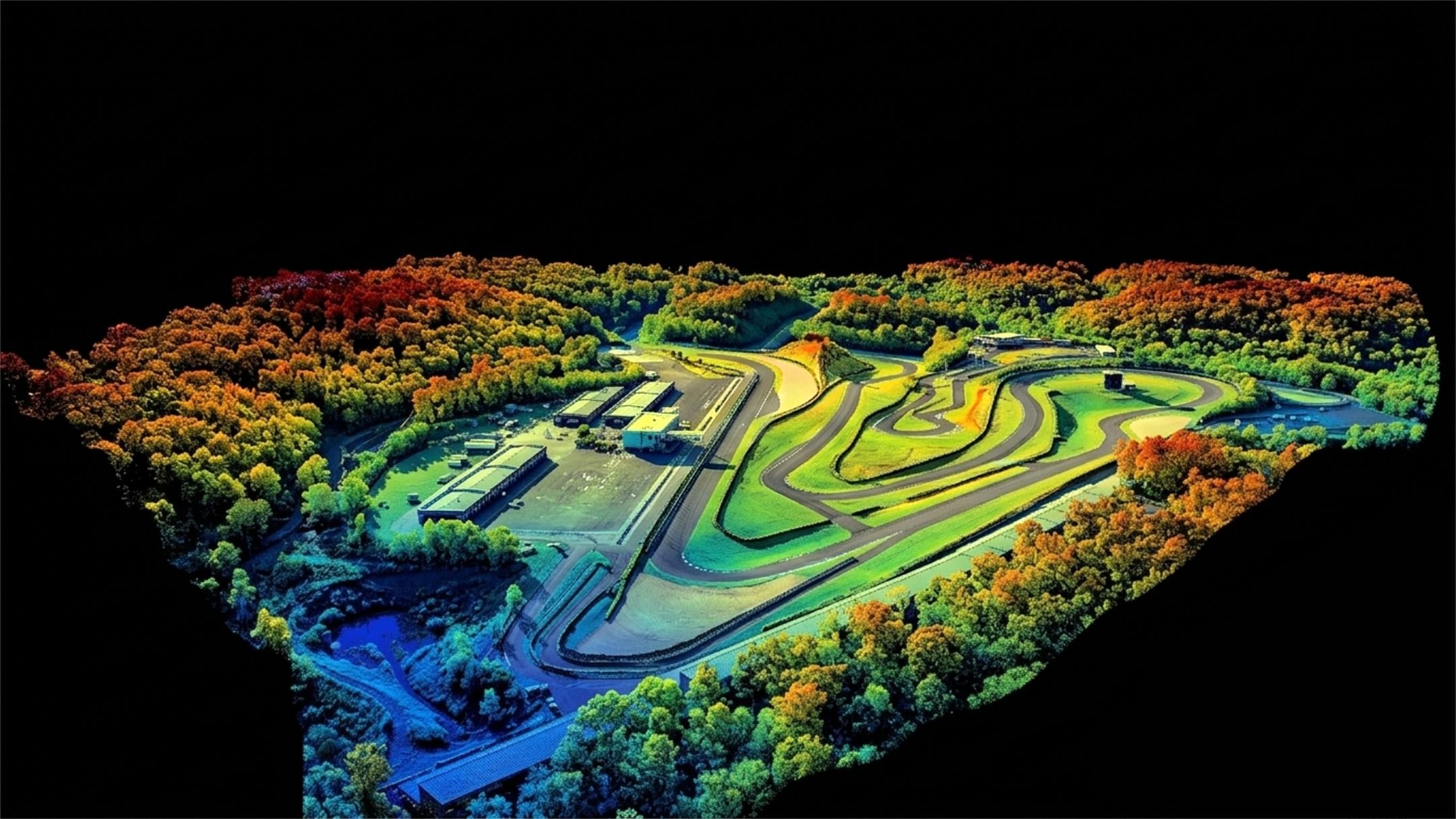
If you've spent any time in sim racing forums, you've seen the debate. One side swears that laser scanned tracks are the only way to train seriously. The other side argues that a talented artist can build a track that's close enough to make the distinction irrelevant.
So who's right? The answer depends on what you're using the simulator for.
What Is LiDAR Scanning?
LiDAR (Light Detection and Ranging) uses millions of laser pulses to create a three dimensional point cloud of a real world environment. When applied to a racetrack, the result is a digital surface that captures every bump, crown, elevation change, camber shift, and drainage ripple on the actual circuit. We're talking millimeter level accuracy across the entire track surface, curbing, and runoff areas.
Titles like iRacing, Assetto Corsa Competizione, and rFactor 2 have invested heavily in LiDAR scanned content.
The data is enormous, often billions of individual points for a single circuit, and converting it into a usable racing surface is a significant technical undertaking. But the result is a digital twin of the real track, not an interpretation of it.
What Does "Artist Built" Mean?
An artist built track (sometimes called "hand built" or "modeled from reference") is created by a 3D artist using satellite imagery, photographs, video, elevation data, and sometimes GPS traces from real laps. The artist reconstructs the circuit visually and spatially, making educated decisions about surface detail, elevation transitions, and track geometry based on available reference material.
Some artist built tracks are remarkably good. Talented modders and professional studios have created circuits that look nearly indistinguishable from their scanned counterparts in screenshots. The visual fidelity can be stunning.
But looking right and feeling right are two very different things.
Where You Actually Feel the Difference
The gap between LiDAR and artist built tracks doesn't show up on a straightaway at full throttle. It shows up in the subtle, accumulated details that your body and your hands process before your brain catches up.
Bumps and Surface Irregularities
Real tracks are not smooth. They have patches, seams, compression bumps under braking zones, and ripples from years of resurfacing. A LiDAR scan captures all of this. An artist might add some generic surface noise, but they can't replicate the specific bump at the exit of turn four that unsettles the rear end if you're half a meter too far left. That kind of detail only exists in the scan data.
If you've ever driven a real track and then jumped into the sim version, the scanned track will remind your hands and feet of things your brain forgot. That's the test.
Elevation Changes
This is the big one. Elevation is incredibly hard to estimate from video and satellite imagery alone. A circuit might look relatively flat on camera but actually have a two meter rise over a 200 meter stretch that completely changes how the car loads through a corner entry. Tracks like Bathurst, Spa, and the Nürburgring Nordschleife are famous for their elevation drama, but even "flat" tracks like Sebring have subtle undulations that affect weight transfer in ways an artist would struggle to replicate with precision.
Camber and Track Crown
Road surfaces are rarely perfectly flat across their width. They crown for drainage, camber through corners, and transition between the two in ways that affect grip levels on each tire independently. LiDAR captures the cross section of the track at every point. An artist might approximate the banking in a high speed corner, but the transitional camber changes between turns, the stuff that makes a car feel "alive" on the real circuit, are almost impossible to guess accurately.
Curbing Geometry
Curbs look simple. They're not. Real curbing varies in height, angle, spacing, and surface texture from corner to corner and even within a single curb. Hitting a scanned curb at speed feels specific and consequential. Hitting a generic modeled curb feels like driving over a speed bump somebody copied and pasted around the circuit.
When Does It Actually Matter?
Here's where the debate gets honest. If you're racing for fun, enjoying hotlap competitions with friends, or exploring tracks you've never visited, an artist built track is perfectly fine. The experience is engaging, the racing is competitive, and the enjoyment is real.
But if you're using simulation as a preparation tool for real track time, the gap matters. Drivers who train on scanned versions of circuits they'll actually race on develop spatial references that carry over to the real thing. They learn braking markers relative to real bumps. They build a feel for elevation changes that matches what the car will actually do. They develop a rhythm through a sequence of corners that isn't just close, it's correct.
Professional racing teams use scanned tracks for exactly this reason. When a driver says the sim "felt like the real thing," they're almost always talking about a scanned circuit.
The Hybrid Approach
Some developers are starting to blend the two methods. A LiDAR scan provides the surface data and geometry, while artists handle the visual environment, trackside objects, vegetation, and atmosphere. This gets you the accuracy where it counts (under the tires) and the visual polish that makes the experience immersive.
It's a smart compromise, and it's likely where the industry lands long term as scanning technology becomes cheaper and more accessible.
The Bottom Line
Can you feel the difference? If you're paying attention, yes. The difference isn't dramatic in a single corner, but it compounds across a full lap and becomes obvious across a full stint. LiDAR scanned tracks feel specific. Artist built tracks feel approximate. Both can be fun, but only one can genuinely prepare you for the real thing.
Your brain might not be able to articulate what's different. But your hands, your feet, and that little voice in the back of your head that says "this doesn't feel right through that kink" will know.
RRG Racing partnered with Lunis Studios to LiDAR scan Atlanta Motorsports Park in Dawsonville, Georgia. To experience the difference for yourself, visit rrgracing.com.
Share:
Can Sim Racing Actually Make You Faster on a Real Track?
RRG Racing: Built at the Track, Built for the Driver