

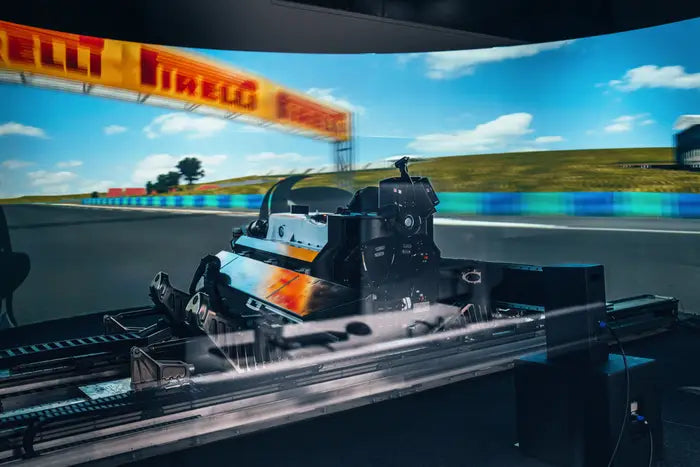
Every Formula 1 team has one. Every major sportscar program relies on one. IndyCar teams, GT teams, NASCAR Cup teams, and even well funded club level operations have invested in simulation technology as a core part of their competitive toolkit.
This is not a trend. It's an arms race.
And the drivers and teams that aren't participating in it are leaving performance on the table every single race weekend.
The Role Has Changed
Ten years ago, a team simulator was primarily a marketing tool with some training value. Sponsors liked the optics. Drivers used it occasionally to familiarize themselves with a new track. But the real development work happened at the racetrack, in the engineering office, and on the dyno.
That equation has flipped. Modern simulation technology has become so accurate, and real world testing opportunities so limited by regulations and cost, that the simulator is now where the majority of development happens between events.
In Formula 1, where in season testing is severely restricted, teams run their simulators around the clock. When the race team is packing up after a Grand Prix, the simulator back at the factory is already running through setup iterations for the next event. The car that arrives at the next circuit has been virtually optimized for days before a single real lap is turned.
This isn't unique to F1. The same dynamic plays out at every level of professional motorsport where the cost of real track time exceeds the cost of sim time, which is to say, virtually every level.
Setup Development: The Silent Advantage
The most impactful use of simulation at the professional level is setup development, and it's the one the public hears the least about.
A race car's setup, the springs, dampers, anti roll bars, ride heights, camber angles, toe settings, and dozens of other adjustable parameters, determines how the car behaves on track. Finding the right combination for a specific circuit and set of conditions is one of the most complex problems in motorsport engineering.
At the track, you get a limited number of practice sessions. Each session is 30 to 60 minutes. Changing a setup parameter, going back out, evaluating the result, and then deciding on the next change takes time. In a single practice session, a team might evaluate three or four setup iterations if they're efficient.
In the simulator, that same team can run 30 or 40 iterations in a single day. They can sweep through spring rate combinations, test different aero configurations, evaluate brake bias settings, and narrow the setup window before the car even arrives at the circuit.
When practice starts on Friday, the team isn't searching for a baseline. They already have one. They're refining. That head start translates directly into more productive practice sessions, a better qualifying setup, and a race configuration that's been validated against hundreds of virtual laps.
Driver Preparation: More Than Just Learning the Track
At the professional level, driver preparation in the simulator goes far beyond learning a circuit's layout. Drivers already know the tracks. What the simulator provides is something more specific and more valuable.
Adapting to regulation changes. When aerodynamic rules change, cars behave differently. New tire compounds change braking and cornering characteristics. A simulator lets drivers recalibrate their instincts for the new car before the first official session. The 2022 Formula 1 ground effect regulation change was a perfect example. Teams that had extensive simulator programs gave their drivers months of seat time in the new concept cars before anyone turned a real lap.
Practicing race scenarios. Professional drivers use simulators to rehearse specific race situations. Wet weather starts. Safety car restarts. Tire degradation management over a full race distance. Fuel saving techniques. These scenarios are difficult or impossible to practice on track, but they can be simulated repeatedly until the driver's responses become instinctive.
Evaluating strategic options. Should we run a one stop or two stop strategy? Where does the crossover happen? What's the pace difference on old tires versus new tires at different fuel loads? Drivers can run these scenarios in the sim and develop an intuitive feel for how the race will unfold, which helps them make better real time decisions on race day.
Recovering from weekends off. In series with gaps between events, drivers use simulators to stay sharp. The neuromuscular coordination required for high performance driving degrades without regular reinforcement. A driver who hasn't been in a car for three weeks can use the simulator to keep their reactions calibrated and their confidence intact.
Engineering Development: The Infinite Test Track
For engineers, the simulator is effectively an unlimited test facility with zero consumable costs.
Aero development. When CFD (computational fluid dynamics) or wind tunnel work produces a new aerodynamic configuration, the simulator is where it gets evaluated in a driving context. Numbers on a spreadsheet tell you downforce and drag. The simulator tells you how those numbers feel to the driver and how they affect lap time in the corners that matter.
Tire modeling. Understanding tire behavior, how grip builds, how it degrades, how it responds to temperature and load, is fundamental to race car performance. Simulators run sophisticated tire models that allow engineers to predict tire behavior across different strategies, then validate those predictions against real world data. The better the tire model, the more accurate the strategy predictions become.
Component failure analysis. What happens if the car loses 10% of its downforce due to front wing damage? How much lap time does a brake issue cost? Can the driver still manage the car safely? These questions can be explored in the simulator without any risk, providing both engineering data and driver familiarity with degraded conditions.
Cost avoidance. Every kilometer of real testing costs money. Fuel, tires, engine wear, crew travel, facility rental, logistics. A full day of private testing for a professional racing team can cost tens of thousands of dollars. A full day of simulator testing costs electricity and an engineer's time. The financial argument for simulation is overwhelming, and it's the primary reason adoption has accelerated so rapidly.
The Correlation Challenge
The most sophisticated aspect of professional simulation is correlation: the process of making the simulator match the real car as closely as possible.
A simulator is only as good as its models. The tire model, the aero model, the suspension model, the engine model, and the track model all need to accurately represent reality for the sim to produce useful data. If any of these models is significantly wrong, the simulator's recommendations will be wrong too, and the team will arrive at the track with a car that doesn't behave as expected.
Professional teams invest enormous resources in correlation. After every race weekend, engineers compare real world data (GPS traces, damper velocities, tire temperatures, lap times, driver feedback) against what the simulator predicted. Discrepancies are analyzed, and the models are updated.
This is an ongoing, iterative process. A team's simulator doesn't reach "done." It gets more accurate over time as more real world data feeds back into the models. The teams with the best correlation, meaning the smallest gap between what the sim says and what the car does, have the biggest competitive advantage because they can trust their simulation results and make bolder decisions based on them.
Who's Doing It at Every Level
Simulation is not just an F1 or top tier phenomenon. The technology has cascaded down through the motorsport hierarchy.
IndyCar and IMSA teams use simulation for both car setup and driver preparation, particularly at street circuits where practice time is severely limited.
GT3 and GT4 programs increasingly rely on simulators for pro am driver development, where getting a gentleman driver up to speed as quickly as possible is critical to team performance.
NASCAR teams use simulation for aerodynamic evaluation, pit strategy development, and track specific setup preparation. The Next Gen car's introduction accelerated simulator investment across the entire Cup Series garage.
National and club level teams are adopting consumer grade and prosumer simulation hardware for driver coaching and track preparation. The cost of entry has dropped to the point where a serious club racer can access simulation quality that would have been exclusive to factory teams a decade ago.
Karting teams and junior programs use simulators to develop young drivers' racecraft and track knowledge. The investment at this level is modest, but the developmental impact is disproportionately large because young drivers learn and adapt faster than anyone.
The Competitive Reality
Here is the uncomfortable truth for any team or driver not using simulation: your competitors are.
They're arriving at the track with their setup window already narrowed. Their drivers have already rehearsed the scenarios that will define the race. Their engineers have already run the strategic analysis that will guide pit stop decisions. They've done all of this before a single wheel has turned on the real surface.
That's not a luxury. That's preparation. And preparation, more than raw talent or equipment, is what separates results in modern motorsport.
The simulator hasn't replaced the racetrack. It never will. But it has become the single most productive tool available for maximizing what happens when you get there. The teams that understood this earliest are the ones winning now. The teams adopting it today are the ones that will be winning next.
RRG Racing builds simulators for teams, coaching programs, and facilities that take preparation seriously. From individual driver rigs to multi station team installations, we design and deliver systems that match professional expectations. Based at Atlanta Motorsports Park in Dawsonville, Georgia. Visit rrgracing.com to explore what's possible.
Share:
The Rise of Corporate Sim Racing Events and Team Building
Setting Up a Simulator for Endurance Racing: What You Need to Know