

Here's a question that sounds simple until you actually think about it: how do you make someone feel like they're going 150 mph while they're sitting in a chair that's bolted to the floor of their office?
That's the fundamental challenge every motion platform has to solve. And the answer is more clever than most people realize, because motion simulators don't actually recreate the forces you feel in a real car. They can't. The physics don't allow it. What they do instead is trick your brain into believing those forces exist, and the way they pull off that trick is one of the most interesting pieces of engineering in the entire sim racing world.
Let's talk about what's actually happening.
The Problem: Real G Forces Are Impossible to Simulate
When you brake hard in a real race car, your body experiences longitudinal deceleration. The seatbelt holds you in place while inertia tries to throw you forward. That sensation of weight pressing into the harness is real force acting on your body, sometimes exceeding 2g in heavy braking zones.
When you corner at speed, lateral g forces push you sideways into the seat bolster. In a high downforce car through a fast corner, you might sustain 2 to 3g of lateral load for several seconds. Your neck works to hold your head upright. Your core muscles engage to keep your body centered.
A motion platform cannot generate these forces. To create sustained 1g of lateral acceleration, you would need a platform that accelerates sideways indefinitely, which would require infinite travel distance. Even the most advanced full motion simulators used by airlines and military applications operate within a finite range of movement, typically measured in inches or at most a few feet.
So if motion platforms can't generate real g forces, what are they actually doing? And why do they feel convincing?
The Answer: Tilt Coordination and Onset Cues
Motion simulation works because of two key principles that exploit how the human body perceives force.
Tilt Coordination
Your inner ear has two systems for detecting motion. The semicircular canals detect rotational acceleration (turning your head, spinning, rotating). The otolith organs detect linear acceleration (speeding up, slowing down, being pulled sideways).
Here's the critical insight: your otolith organs cannot distinguish between linear acceleration and gravitational tilt. To your vestibular system, tilting 10 degrees to the right feels identical to being pushed sideways by a lateral force. Your brain interprets both the same way.
Motion platforms exploit this by tilting the entire rig in the direction of the simulated force. When you brake in the sim, the platform tilts forward. Your body feels a subtle pull toward the front of the rig, and your brain interprets it as deceleration. When you corner left, the platform tilts to the left, and your brain perceives lateral load.
The tilt has to be slow enough that your semicircular canals don't detect the rotation itself. If the platform tilts too quickly, you feel yourself rotating, and the illusion breaks. The magic is in the speed of the tilt: slow enough to be imperceptible as rotation, but sufficient to redirect gravity in a way that your otolith organs read as linear force.
This is called tilt coordination, and it's the primary mechanism by which every motion simulator in the world creates the sensation of sustained g forces.
Onset Cues
Tilt coordination handles sustained forces, the constant lateral load through a corner, the steady pressure of braking. But real driving is full of sudden transitions: the initial hit of the brakes, the snap of the car rotating into a corner, the jolt of hitting a curb.
These rapid transients are handled by onset cues. The platform makes a quick, sharp movement in the direction of the force at the moment it begins, giving your body the initial "punch" of the event. After the onset, the platform slowly returns to a neutral position while tilt coordination takes over to sustain the sensation.
Your brain processes the onset cue as the beginning of the force event, then the tilt maintains the perception that the force continues. By the time the platform has returned to its travel center, your vestibular system has already accepted the sustained tilt as the ongoing force. The transition is seamless if the tuning is done well.
This combination of onset cues for transients and tilt coordination for sustained forces is what makes a properly tuned motion platform feel convincing. Neither technique alone would work. Together, they create a continuous feedback loop that your body trusts.
Degrees of Freedom: What They Mean and What They Do
Motion platforms are categorized by their degrees of freedom (DOF), which describes how many independent axes of movement the platform can produce.
2DOF systems typically provide pitch (forward/backward tilt) and roll (side to side tilt). These are the two most important axes for racing because they correspond to braking/acceleration forces and cornering forces. A well tuned 2DOF platform can deliver a surprisingly convincing experience for the investment because it covers the two sensations that matter most in a race car.
3DOF systems add heave (vertical movement). Heave is what you feel when you hit a curb, ride over a bump, or crest a hill. Adding this axis introduces a new dimension of surface feedback that 2DOF platforms can't replicate. For tracks with significant surface detail, bumps, and elevation changes, the third axis adds meaningful information.
4DOF through 6DOF systems add combinations of surge (forward/backward linear movement), sway (side to side linear movement), and yaw (rotational movement around the vertical axis). Full 6DOF platforms can produce motion in every axis simultaneously, providing the most complete motion envelope possible.
Each additional axis adds realism, but also adds cost, complexity, and tuning difficulty. There's a clear point of diminishing returns for most users. A well tuned 3DOF system will feel dramatically better than a poorly tuned 6DOF system. The quality of the tuning matters more than the number of axes.
Actuator Types: What Moves the Platform
The physical mechanism that creates the movement matters as much as the software controlling it. There are three main actuator types used in sim racing motion platforms.
Pneumatic actuators use compressed air to move the platform. They can be fast and responsive but require an air compressor, which adds noise, space requirements, and maintenance. Pneumatic systems are less common in home setups but are found in some commercial installations.
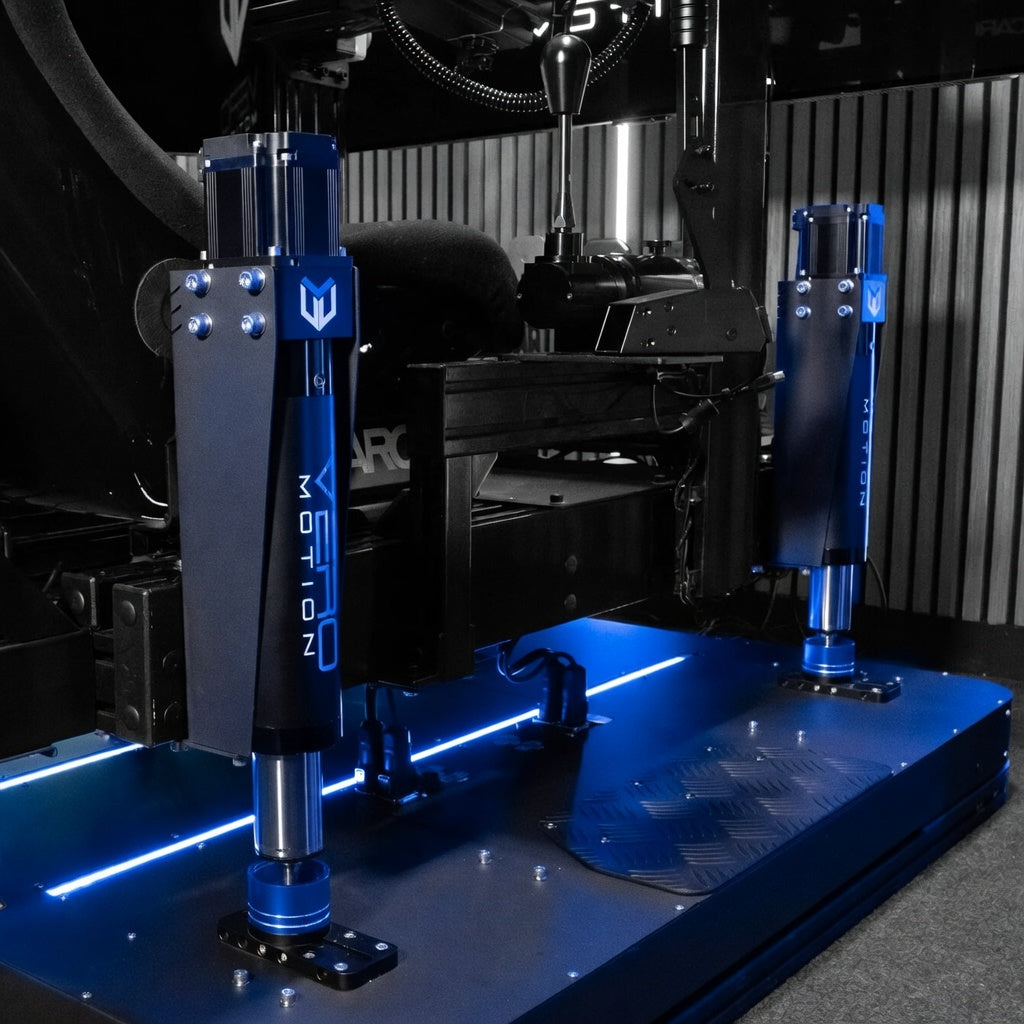
Electric motor actuators are the most common type in modern sim racing platforms. They use electric motors (often servo motors or stepper motors) to drive the platform through mechanical linkages, lead screws, or belt systems. Electric actuators are quiet, precise, controllable, and require minimal maintenance. Most consumer and prosumer motion platforms use electric actuation.
Hydraulic actuators use fluid pressure to generate movement. They can produce enormous force and very smooth motion profiles, which is why they're the standard in full flight simulators and high end commercial installations. For home sim racing, hydraulic systems are rare due to cost, complexity, and the potential for fluid leaks.
For the majority of sim racers, electric actuator platforms offer the best balance of performance, reliability, and practicality. The technology has matured significantly in the last five years, and modern electric platforms can produce fast, precise movements that rival hydraulic systems at a fraction of the cost and complexity.
The Software Layer: Where the Magic Actually Lives
Here's something most people don't appreciate until they experience a poorly tuned motion platform: the hardware is only half the equation. The software that translates sim telemetry data into actuator commands is what determines whether the motion feels natural or nauseating.
Motion software reads data from the sim in real time: lateral g, longitudinal g, vertical acceleration, yaw rate, roll, pitch, and other channels depending on the platform. It then applies a series of filters, scaling curves, and timing adjustments to translate that data into physical movement.
Scaling determines how much of the sim's reported force gets translated into platform movement. If lateral g is scaled too high, the platform will slam to its travel limit in every corner. Too low, and you won't feel anything. Getting this balance right is the first and most important tuning step.
Filtering smooths out the motion to prevent jerky, unnatural movements. Raw telemetry data can be noisy, and without filtering, the platform would vibrate and twitch in ways that feel nothing like a real car. But over filtering makes the motion feel sluggish and delayed. The sweet spot is smooth enough to feel natural, but responsive enough to deliver onset cues with authority.
Washout algorithms manage the platform's return to center after a movement. When the platform tilts to simulate cornering load, it can't stay tilted indefinitely because it would run out of travel for the next input. Washout algorithms gradually and imperceptibly return the platform toward its neutral position so it has range available for the next event. The quality of the washout directly affects how seamless the experience feels.
Axis mixing determines how the platform handles simultaneous inputs on multiple axes. Trail braking into a corner, for example, produces both longitudinal and lateral forces at the same time. The software needs to blend pitch and roll movements simultaneously without either one overwhelming the other or the platform running out of travel.
Good motion software makes all of this invisible. You don't feel the tuning. You don't feel the washout. You just feel the car. Bad motion software makes you feel the platform, and that's when motion becomes a distraction rather than an enhancement.
What Meaningful Feedback Actually Feels Like
When everything is working, a properly tuned motion platform delivers information to your body that changes how you drive. Not theoretically. Practically.
Braking: You feel the initial bite of the brakes through a subtle forward pitch. As you modulate deeper into the braking zone, the sustained tilt tells your body how much deceleration you're carrying. Releasing the brakes brings the platform back to neutral, and you feel the weight transfer rearward as you transition to throttle.
Cornering: The onset cue as you turn in gives you the initial hit of lateral load. As you hold the corner, tilt coordination sustains the sensation. You feel the car load up, hold, and unload as you unwind the steering. Mid corner corrections produce subtle shifts in roll that communicate exactly what the tires are doing.
Oversteer: This is where motion earns its reputation. When the rear of the car steps out, you feel it through a rapid roll or yaw onset before your eyes confirm it on screen. That fraction of a second of early warning through your body is often enough to catch the slide with a correction that feels instinctive rather than reactive.
Surface and curbing: Heave axis movement lets you feel curbs as discrete events, the thump of each tooth, the sustained vibration of a rumble strip. Bumps in the track surface become physical sensations that inform your driving rather than just visual distractions.
This is what separates a motion platform from a gimmick: when the feedback is meaningful, it changes your behavior in ways that make you a more informed and instinctive driver.
Common Misconceptions
"Motion makes you faster." Not necessarily. Motion gives you more information, which can help you make better decisions. But many of the fastest sim racers in the world compete on static rigs. Motion is about immersion and information, not automatic lap time improvement.
"More movement equals more realism." The opposite is often true. Aggressive, large amplitude motion that throws you around in the seat doesn't feel like driving a car. It feels like being on a ride. Real driving forces are often subtle, and the best motion setups reflect that by keeping movements controlled and purposeful.
"Motion causes sim sickness." Poor motion can cause discomfort. Well tuned motion with proper washout and appropriate scaling rarely does. In fact, many people who experience nausea on static rigs (because the visual input doesn't match the lack of physical feedback) find that motion actually reduces discomfort by providing the physical cues their brain is expecting.
The Takeaway
Motion platforms don't recreate reality. They reinterpret it. Through tilt coordination, onset cues, and carefully tuned software, they give your vestibular system just enough information to construct a convincing perception of forces that aren't actually there.
When it works well, the effect is remarkable. Your body responds to the car naturally. Your corrections feel instinctive. Your connection to the vehicle deepens in a way that no amount of visual fidelity or force feedback can achieve alone.
The engineering behind this is fascinating, but the experience doesn't require you to understand any of it. You just sit down, and for the first time, you don't just see and hear the car. You feel it.
RRG Racing builds motion and static simulators tuned for the way you actually drive. Whether you're exploring your first 3DOF platform or speccing a full motion rig, we match the hardware and the tuning to your goals. Based at Atlanta Motorsports Park in Dawsonville, Georgia. Visit rrgracing.com to get started.
Share:
What Makes a Simulator "Turnkey"
Single Screen, Triples, or VR? Choosing the Right Visual Setup for Your Budget