

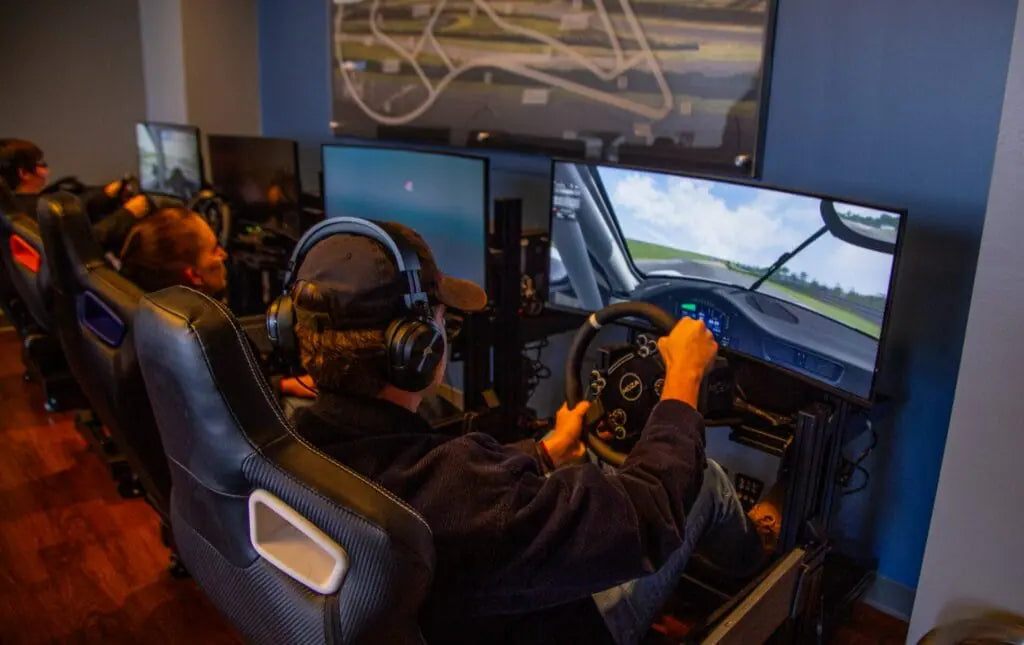
You've seen sim racing explode over the last few years. You've watched entertainment venues, karting facilities, and motorsports parks install rigs and fill seats. And now you're asking the obvious question: should we add simulators to our operation?
The answer is almost certainly yes. But the difference between simulators that generate revenue and simulators that collect dust comes down to something most operators overlook entirely.
You need to give people a reason to come back.
The Biggest Mistake Venue Operators Make
Here it is, upfront, before we talk about hardware or floor plans or pricing models: the single most common failure in venue based sim racing is installing equipment without building a purpose around it.
A row of simulators is not a business model. It's furniture.
If someone walks in, drives for 20 minutes, says "that was cool," and never returns, you haven't built anything. You've created a novelty. Novelties generate curiosity the first time and indifference the second.
The venues that succeed with simulators are the ones that give their customers a goal. Something to work toward. Something to come back for. Something that turns a casual visitor into a regular.
This is the most important strategic decision you'll make before you buy a single piece of equipment.
Goals Drive Retention
Think about why people return to anything repeatedly. Gyms have progress tracking. Golf courses have handicaps. Karting centers have league nights and lap records. The activity alone isn't enough. The structure around the activity is what creates habit.
Simulators are no different. Here's what goal driven programming looks like in practice:
Leaderboards. A visible, always updated leaderboard creates instant motivation. When someone sees their name on the board, they want to protect their position. When they see someone faster, they want to beat them. When they're close to cracking the top ten, they'll book another session just to try. This is the simplest goal structure you can implement and one of the most effective.
League nights. Weekly or biweekly racing leagues give customers a recurring reason to show up. Registration, points standings, season championships, and end of season awards create community and commitment. A customer who joins a league isn't booking individual sessions anymore. They're committing to a season. That's the difference between transactional revenue and recurring revenue.
Progression systems. Borrow from the sim platforms themselves. iRacing's license system works because it gives drivers something to earn. You can create a similar structure at your venue: beginner, intermediate, advanced tiers with specific benchmarks to hit before moving up. Customers who are working toward the next level will keep coming back until they get there.
Track day preparation packages. If your venue is attached to or near a real motorsports facility, this is an enormous opportunity. Offer structured sim sessions specifically designed to help drivers learn the track before their real world event. Pair it with data review and coaching. Give them a package that includes sim time, track walk notes, and a debrief. Now the simulator isn't entertainment. It's a training tool with a specific, measurable outcome.
Corporate and group competition. Companies are always looking for team building activities that feel exciting without being dangerous. Sim racing checks every box. But a corporate group that just does a few casual laps will leave saying it was fun. A corporate group that competes in a structured mini championship with qualifying, heats, a final, and a trophy will leave saying it was one of the best team events they've ever done. Structure creates memorable experiences. Memorable experiences create repeat bookings and referrals.
The point is this: before you reach out to spec a single rig, define what the goal is for the people who will use them, or ask us and we'll help you find that goal. Everything else, the hardware, the layout, the pricing, flows from that answer.
Choosing the Right Equipment
Once you know your programming strategy, the equipment decisions become much clearer.
How Many Rigs?
This depends on your primary use case. If leagues are your focus, you need enough rigs to run a competitive field. Six is the minimum for meaningful wheel to wheel racing. Eight to twelve is the sweet spot for most venues. If your focus is walk in entertainment and corporate events, four to six rigs can work, but you'll want them spec'd for durability and quick turnaround between customers.
More rigs means more capacity, but also more floor space, more PCs, more maintenance, and more staff. Don't overbuild on day one. Start with a number that matches your projected demand and leave room to expand.
What Level of Equipment?
Venue rigs need to hit a specific balance: impressive enough to wow first time visitors, durable enough to survive thousands of sessions per year, and simple enough for staff to manage without a dedicated IT team.
For wheelbases, direct drive is the standard for any serious venue. Belt driven units feel noticeably less impressive and won't hold up to the volume. Look for units in the 8 to 15Nm range, strong enough to deliver real force feedback without being so powerful that an inexperienced customer gets overwhelmed.
Pedals should be load cell at minimum. This is non negotiable for any venue positioning itself as more than a casual arcade. Load cell braking is what separates a real simulator from a gaming setup, and your customers will feel the difference immediately.
Screens versus VR is a significant decision. Triple monitor setups are the industry standard for venues because they're visually impressive, easy for spectators to watch, and don't require individual headset management. VR offers deeper immersion but introduces hygiene concerns, longer setup times between customers, and motion sickness issues for a percentage of your audience. Most successful venues run triples as their primary setup and offer VR as an optional upgrade on select rigs.
The Chassis and Seat
Venue rigs take abuse. Period. Customers of all sizes will sit in them, adjust them, and occasionally be rougher than you'd like. Your chassis needs to be overbuilt compared to a home rig.
Aluminum profile frames are ideal because they're rigid, adjustable, and repairable. If a bracket breaks or a component needs repositioning, you can fix it with basic tools instead of replacing the entire frame.
Seats should be comfortable for a wide range of body types and easy to clean. Avoid fabric upholstery. Vinyl or synthetic leather wipes down between sessions and holds up over time.
Software Selection
Your sim platform choice should align with your goals. If you're running leagues and attracting the competitive crowd, iRacing or Assetto Corsa Competizione are strong choices. If your audience leans more toward casual entertainment and corporate groups, Assetto Corsa with curated car and track selections offers a more accessible experience without sacrificing realism.
Whatever platform you choose, build a library of preloaded setups that staff can launch quickly. A customer shouldn't have to wait five minutes while someone configures their session. One click, sit down, drive.
Layout and Space Planning
The physical arrangement of your sim area matters more than most operators realize.
Visibility from the entrance. If possible, position your rigs where people walking into your facility can see them in action. Simulators are inherently visual. Screens glowing, wheels spinning, drivers leaning into corners. That's free marketing for every person who walks through your door.
Spectator space. Leave room for people to watch. Friends watching friends race is how casual interest turns into "I want to try that." Don't pack rigs so tightly that there's no room for an audience.
Sound management. Simulators generate noise, wheel motors, audio from the sims, excited customers. If your sim area is adjacent to a lounge, retail space, or office area, plan for sound isolation or at least sound dampening.
Climate control. Sim rigs generate heat. PCs generate heat. Customers generate heat. A room full of running rigs with no adequate cooling will become uncomfortable fast. Plan your HVAC around peak capacity, not average load.
Network infrastructure. Online racing requires stable, low latency internet. Hardwire every rig with ethernet. Do not rely on WiFi for competitive sim racing. A single lag spike during a league race will cost you credibility with your serious customers instantly.
Pricing Strategy
There's no single right pricing model, but there are a few principles that work across different venue types.
Per session pricing is the baseline. Charge by the half hour or hour for walk in customers. Keep it simple and post rates clearly.
Membership and subscription models are where the real business is. Monthly memberships that include a set number of hours, league entry, and priority booking create predictable recurring revenue and committed customers. This is the model that scales.
Event packages for corporate groups, birthday parties, bachelor events, and team outings should be priced as complete experiences, not just by the hour. Include race formats, a host or facilitator, results printouts, and if possible, a small awards ceremony. You're selling an experience, not seat time.
Loyalty and progression incentives. Tie discounts or perks to your progression system. A customer who reaches "advanced" tier gets a small discount on their membership or a free session. This reinforces the goal structure and rewards engagement.
Staffing and Operations
Simulators are not self service, at least not if you want to do this well.
You need at least one staff member who understands the equipment, the software, and basic troubleshooting. Wheels need recalibration. Software crashes. Pedals need adjustment between customers of different heights. PCs need updates. These are all minor issues, but if no one on staff can handle them, minor issues become major downtime.
For league nights and events, you'll want someone who can manage race formats, communicate with participants, and keep things running on schedule. This is the host, the race director, the person who turns a group of individuals into a community.
Training your team to reset rigs quickly between customers is also critical. The faster you can turn a rig around, the more sessions you can run per day. Build a checklist: wipe down the seat and wheel, confirm pedal position, load the default setup, ready for the next driver. Two minutes, tops.
The Revenue Opportunity Most Operators Miss
Here's something that almost no one does on day one but everyone wishes they had started sooner: sim time as a complement to real track time.
If your venue is at or near a racetrack, the simulator is not a separate product. It's an extension of the track experience. Drivers preparing for a track day, a race weekend, or a coaching session can use the simulator to learn the circuit, review data, and practice specific techniques before spending money on tires and fuel.
This isn't hypothetical. We've seen drivers at Atlanta Motorsports Park use the simulators to prepare for events and arrive significantly more prepared than drivers who didn't. The simulator becomes part of the customer's training workflow, not just an add on entertainment option.
That integration is what turns a sim area from a nice to have into a profit center.
Final Thought
Simulators will attract attention. They're flashy, they're exciting, and they tap into a market that's growing every year. But attention without structure is just foot traffic. The venues that win with simulators are the ones that answer one question before anything else:
What is the goal for the person sitting in this rig?
Answer that, build your programming around it, and the equipment, the layout, and the revenue will follow.
RRG Racing builds turnkey simulators for venues, training programs, and private installations. Along with custom venue and event management software. Based at Atlanta Motorsports Park in Dawsonville, Georgia, we understand what it takes to make simulators work in a real world facility because we operate in one every day. Visit rrgracing.com to start the conversation.
Share:
From Sim to Seat: Drivers Who Made the Jump from Virtual to Real Racing
Why Track Operators Should Consider Getting Their Facility Scanned