

Ten years ago, telling someone you learned to race by playing video games would get you laughed out of the paddock. Today, it gets you a contract.
The sim to real pipeline is no longer a novelty story or a marketing gimmick. It's a legitimate, proven pathway that has produced professional drivers competing at Le Mans, in Formula 2, in Super GT, in NASCAR, and across nearly every major racing discipline on the planet. The drivers who made these jumps didn't get lucky. They put in the work on a simulator, developed skills that transferred directly to a real cockpit, and proved that the line between virtual and real motorsport is thinner than the old guard ever wanted to admit.
Here are the stories that matter.
Jann Mardenborough: The One Who Started It All
If there's a single name that defines the sim to real movement, it's Jann Mardenborough.
In 2011, Mardenborough was a 19 year old from Cardiff, Wales, with no karting background, no racing budget, and no connections to the motorsport world. What he had was a PlayStation and thousands of hours of Gran Turismo under his belt.
He entered the GT Academy competition, a joint program between Nissan and the creators of Gran Turismo designed to find real racing talent among gamers. Out of 90,000 entrants, Mardenborough won. He had never driven a high performance car. He had never been on a real racetrack. And within a year, he was racing professionally for Nissan.
What followed was a career that silenced every skeptic. Mardenborough competed in the 24 Hours of Le Mans, won races in GT3 competition, earned a pole position in Super Formula, raced in the top class of Super GT in Japan for four seasons, and worked as a simulator driver for Nissan's Formula E program. His story became so iconic that Sony Pictures turned it into a feature film, simply titled "Gran Turismo," released in 2023.
Mardenborough himself put it best: his 10,000 miles weren't done in a kart. They were done on Gran Turismo. And those miles counted.
James Baldwin: World's Fastest Gamer to Real World Winner
James Baldwin took a different but equally remarkable path. In 2019, he won McLaren's World's Fastest Gamer competition, beating some of the best sim racers on the planet to earn a role as a simulator driver for the McLaren Formula 1 team.
But Baldwin didn't want to stay behind a screen. He used that opportunity as a launching pad into real world competition, transitioning into GT racing. He earned his place in the BRDC British Drivers Club, a program that has historically developed some of the UK's best racing talent, and began competing in the Porsche Carrera Cup Deutschland.
What made Baldwin's transition notable wasn't just that he was fast. It was that he understood car development. His years in sim racing gave him an engineer's understanding of vehicle dynamics, setup changes, and data analysis. When he sat down with real race engineers, he spoke their language. That's a skill set that sim racing builds quietly in the background, and it's one that teams increasingly value.
Cem Bölükbasi: From F1 Esports to Formula 2
Cem Bölükbasi's story broke new ground entirely. The Turkish driver competed in the F1 Esports Series, proved himself among the best virtual racers in the world, and then did something no esports racer had ever done before: he earned a seat in Formula 2.
Formula 2 is the final step before Formula 1. It is one of the most competitive junior racing series on Earth. And Bölükbasi got there with a foundation built on sim racing.
His path wasn't overnight. After F1 Esports, he transitioned into the GT4 European Championship to build real world experience, then moved into the F3 Asian Championship before earning his F2 opportunity. But the starting point, the thing that opened every door that followed, was a wheel and a set of pedals.
Bölükbasi has been vocal about the significance of his journey. He's said publicly that without F1 Esports, he never would have had the chance to get into a real car. He wants his story to give hope to anyone sitting in front of a screen with talent but no traditional racing budget.
Jeff Giassi: Sim Racer Turned Porsche Instructor
Jeff Giassi's trajectory is one of the most complete sim to real stories in the sport because it didn't stop at driving.
Giassi built his reputation in the Porsche TAG Heuer Esports Supercup. When Porsche Brazil reached out and asked what it would take for him to represent their brand in virtual competition, his answer caught everyone off guard. He didn't ask for money. He asked for test days in a real Porsche 911 GT3 Cup car.
Porsche gave him five days on a real track, followed by a race at the finale of the Porsche Cup Brasil endurance season. At Interlagos, the legendary home of the Brazilian Grand Prix, Giassi qualified on pole position and battled for the lead against Porsche Junior drivers with years of real world experience. Only a drive through penalty kept him from winning outright.
Since then, Giassi has become a certified Porsche instructor and coach, training drivers at every level from beginners to championship contenders in the real Porsche Cup Brasil. His sim racing expertise became a core part of his coaching methodology. Training sessions often begin in the simulator before drivers ever hit the track, and Giassi's ability to bridge both worlds makes him uniquely effective.
He went from playing a racing game to coaching professional racing drivers. That's not a story about talent alone. That's a story about how deeply sim racing skills translate when the right opportunity meets the right preparation.
Sebastian Job: From iRacing Champion to Red Bull F1 Test Driver
Sebastian Job won the Porsche TAG Heuer Esports Supercup twice, establishing himself as one of the most dominant sim racers of his generation. Red Bull Racing took notice.
Through Red Bull's "Game to Glory" program, Job was given the chance to progress through real race cars in a structured development path, culminating in the ultimate test: driving Sebastian Vettel's title winning RB8 Formula 1 car.
Red Bull's head of esports said Job performed remarkably well during the test. His ability to process information, adapt to the car, and deliver consistent performance under pressure were skills honed over years of high level sim competition. The transition wasn't effortless, and nobody claimed it was simple, but the foundation was undeniably there.
Job's story illustrates something important about the sim to real conversation: the skills that make someone elite in a simulator, consistency, spatial awareness, racecraft, the ability to extract performance under pressure, are the same skills that define elite real world racers.
NASCAR's Sim Pipeline
The American stock car scene has quietly produced some of the most significant sim to real transitions in the sport.
Anthony Alfredo and Ty Majeski both started on their computers and are now full time competitors in NASCAR's major national series. The eNASCAR Coca Cola iRacing Series, one of the most prestigious sim racing championships in the world, has become a legitimate feeder system for real world opportunities.
The connection runs even deeper than driver development. When Tyler Reddick won at Circuit of the Americas, he credited sim racer Keegan Leahy from 23XI Racing's eNASCAR program with helping prepare him for the event. The virtual and real sides of the team were working together, sharing data and strategy, blurring the boundary between the two in exactly the way the sport is heading.
Racing Prodigy: Building the Pipeline at Scale
Every story above involves an individual driver finding their own path from screen to seat. Racing Prodigy is building the infrastructure to make that path systematic.
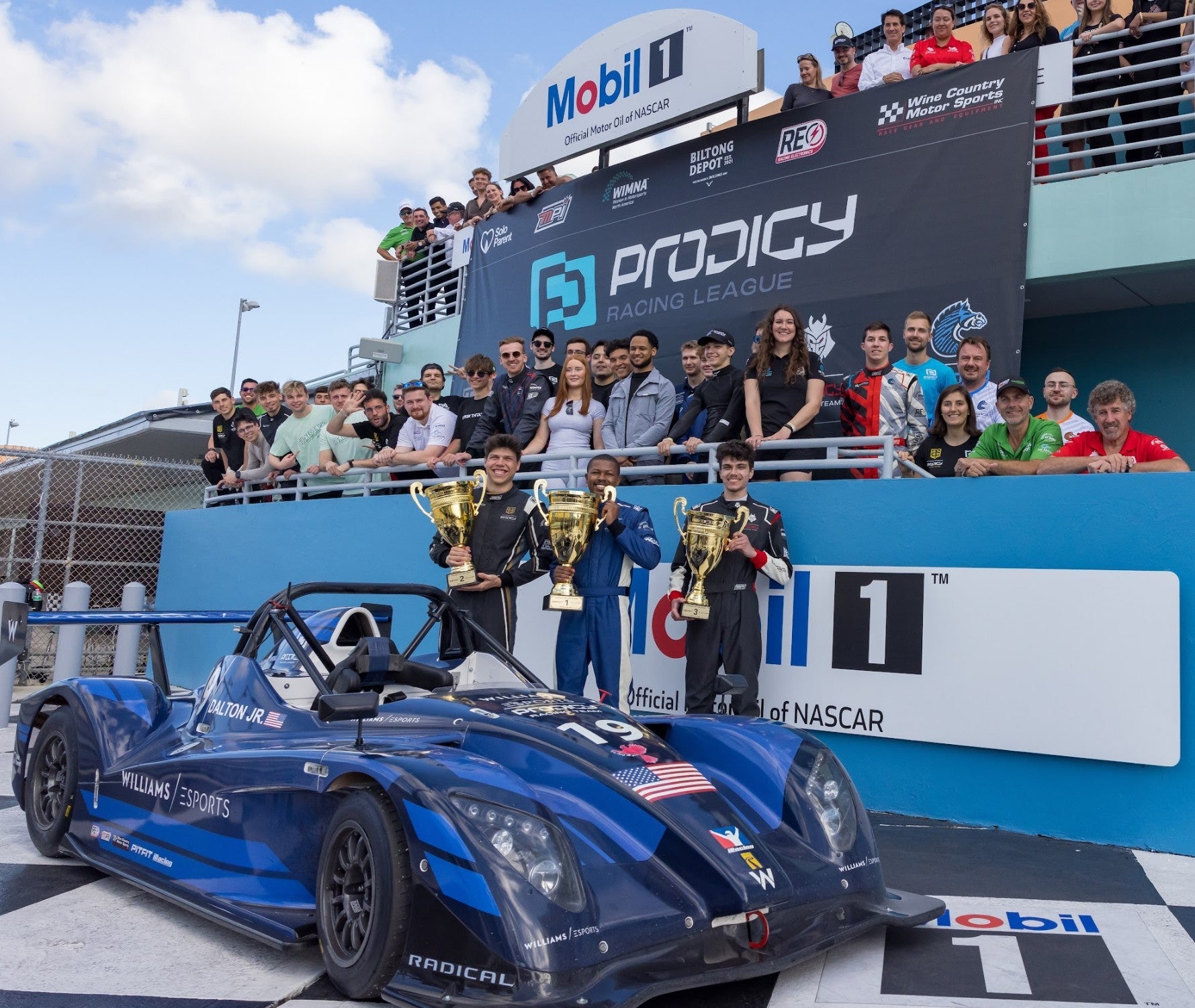
The Prodigy Racing League is the world's first e2Real sports league, designed from the ground up to identify talented sim racers and transition them into professional real world competition. The structure is straightforward: compete in sim racing tournaments across platforms like iRacing, RaceRoom, and Street Kart Racing. Win a Prodigy Pass. Earn an all expenses paid trip to Prodigy Week, where drivers undergo real world training, fitness evaluation, and seat time in Radical SR1 race cars.
The best performers are drafted onto professional racing teams with paid contracts to compete in the Prodigy Three Championship, the first tier of Racing Prodigy's three level competitive ladder. Season one saw 55 sim racers from 21 countries earn Prodigy Passes, with 24 drivers ultimately being drafted by six teams at the Formula One British Grand Prix inside the Williams Racing Fan Zone. The drafted drivers ranged in age from 15 to 29, representing 13 countries and including two female competitors.
What makes Racing Prodigy's model significant is the scale and the intentionality. This isn't a one off competition or a publicity stunt. It's a structured league with seasons, coaching, team ownership, and a multi tier championship system designed to develop drivers over time.
And here's the detail that hits close to home: Prodigy Week takes place at Atlanta Motorsports Park in Dawsonville, Georgia. The same facility where RRG Racing is based. The sim racers earning their shot at a real racing career are doing it on the same track where our simulators run every day. The pipeline from virtual to real doesn't get much more literal than that.
What These Stories Actually Prove
It's easy to read these stories as feel good underdog narratives. And they are. But the deeper takeaway is more practical than inspirational.
The skills transfer. Every single one of these drivers demonstrated that sim racing builds real, applicable racing skills. Not approximations. Not "close enough." Actual skills that hold up at the highest levels of professional motorsport. Braking technique. Racing lines. Spatial awareness. Racecraft in traffic. Car setup understanding. Data analysis. Consistency under pressure. These are not different skill sets for sim and real. They are the same skill set applied in different environments.
The barrier to entry has moved. Motorsport has always been one of the most expensive sports on Earth. A single season of competitive karting can cost $20,000 to $50,000 or more. A season of formula car racing can run into six figures. Sim racing reduces that barrier to the cost of a rig and an internet connection. It doesn't eliminate the cost of real world racing, but it gives talented drivers a way to prove themselves before they need to find that budget.
Teams are paying attention. This isn't a grassroots movement happening in isolation. McLaren, Red Bull, Porsche, Nissan, NASCAR, and now organizations like Racing Prodigy are investing real resources into identifying and developing sim talent. The motorsport industry has accepted that the next great driver might not come from a karting academy. They might come from a bedroom.
The path is getting clearer. Five years ago, making the jump from sim to real required exceptional talent, exceptional luck, and usually a competition that happened to exist at the right time. Today, there are structured pathways: Racing Prodigy's league system, manufacturer esports programs, team affiliated sim racing divisions. The infrastructure is being built, and it's only going to grow.
Where This Is All Going
The stories in this article are not the end of the sim to real movement. They're the beginning. As simulation technology improves, as motion platforms and active feedback systems close the fidelity gap even further, and as organizations like Racing Prodigy scale their development pipelines, the number of drivers making this transition is going to accelerate.
The kid sitting in front of a screen right now, turning laps at midnight because they can't afford a kart, is the same kid who might be standing on a professional podium in five years. That's not a fantasy anymore. It's a documented, repeatable reality.
The only question left is whether you're building the skills now to be ready when the opportunity comes.
RRG Racing is proud to be based at Atlanta Motorsports Park, the same facility where Racing Prodigy holds Prodigy Week and where the next generation of sim to real drivers is being developed. Whether you're chasing a Prodigy Pass, preparing for your first track day, or building a home rig to sharpen your skills, we build simulators designed to make the jump from virtual to real as seamless as possible. Visit rrgracing.com to get started building a simulator.
Share:
Track Day Prep: Using a Simulator to Learn a Circuit Before You Arrive
Adding Simulators to Your Motorsports Venue: What Operators Need to Know